
As mentioned in my previous blog, the vicious cycle concept has been researched and developed by Dr. Ian Stokes. Simply stated, it describes how environmental and physiological factors contribute to the progression of a curvature once that curve has passed a certain limit. About 25 degrees is the generally acknowledged tipping point. What are these factors, and how do they reinforce curvature?
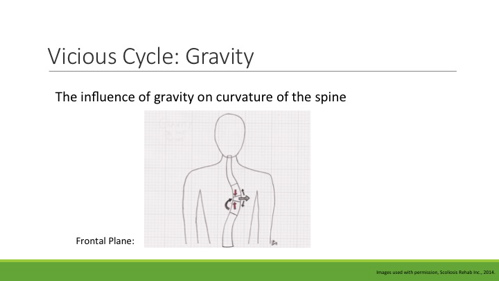
- 1) Gravity – the constant attraction downwards is an essential grounding force for life on earth. However, gravitational pull acting on a curved spine will further compress the concave or short and tight areas which will reinforces the curvatures.

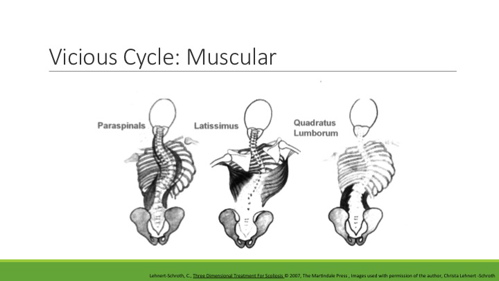
- 2) Muscle Imbalance – this has been cited as the strongest influence on bony growth, greater than weight distribution.* When the spine curves sideways, muscles on the prominent or expanded side are generally over-stretched and weak, muscles on the concave or contracted side are generally short, tight and weak. Both muscle groups are weakened and both continue the progressive deformation when a person continues to move and position themselves in their habitual imbalance. Shortened muscles become shorter and tighter; lengthened, weakened muscles cannot counterbalance the pull and continue to lengthen. Because muscles attach to bones, the position of the bones reinforces muscle position ( both lengthened and shortened) and, in turn, imbalanced muscles reinforce imbalanced bony position, reinforcing spinal curvatures.
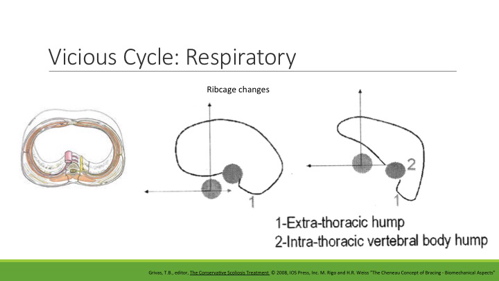
- 3) Breathing occurs continuously. It is the source of our life energy. In a person with exaggerated curvatures, the ribcage begins to change shape, or it may be the other way round. These ribcage changes, in a person with advanced scoliosis, is what causes the prominence of the left front ribs and the prominence of the right back ribs ( in the most commonly seen pattern). Air follows the path of least resistance. Deep breathing will tend to reinforce imbalances in the ribcage thereby reinforcing curvatures of the spine.
- 4) Body Schema- the brain is body’s central command station. In order to move and function, the brain must be constantly aware or where we are in space an of all the internal relationships. Our sensory nervous system constantly sends information about position, muscle length, and a multitude of other factors to the brain. This is the process of “proprioception”. This information is used by the brain to determine motor output or how we move. The brain’s map of ourselves is called the “body schema”. Our brain becomes accustomed to our habitual postures and movement patterns. As we persist in unbalanced movements and alignment, the brain begins to accept this as our normal baseline. The body schema now begins to reinforce the curvature.
- 5) Gait – our primary form of locomotion is walking. Balanced walking requires the ability to stand equally well on the right and left legs during stance to swing phase of gait. In a person with advanced curvatures, weight bearing is no longer equal on the right and left sides. The walking pattern is imbalanced according to the curve type. Every step now reinforces the imbalance.
But wait – All of these same factors: gravity, muscle imbalance, breathing, body schema and gait, are utilized in scoliosis specific rehabilitation to balance the curvature. This discussion will follow in the next blog. The earlier a curvature is addressed, the easier it is to reform the body. Nevertheless, the active practice of balancing body and function is powerful at any age. And, whenever the process is initiated, it will empower the practitioner for their life.
*Biomechanical spinal growth modulation and progressive adolescent scoliosis-a test of the ‘vicious cycle’ pathogenic hypothesis: Summary of an electronic focus group debate of the IBSE, Stokes
